
Sugar Wholesale Price Today: Live Cheeni Rates
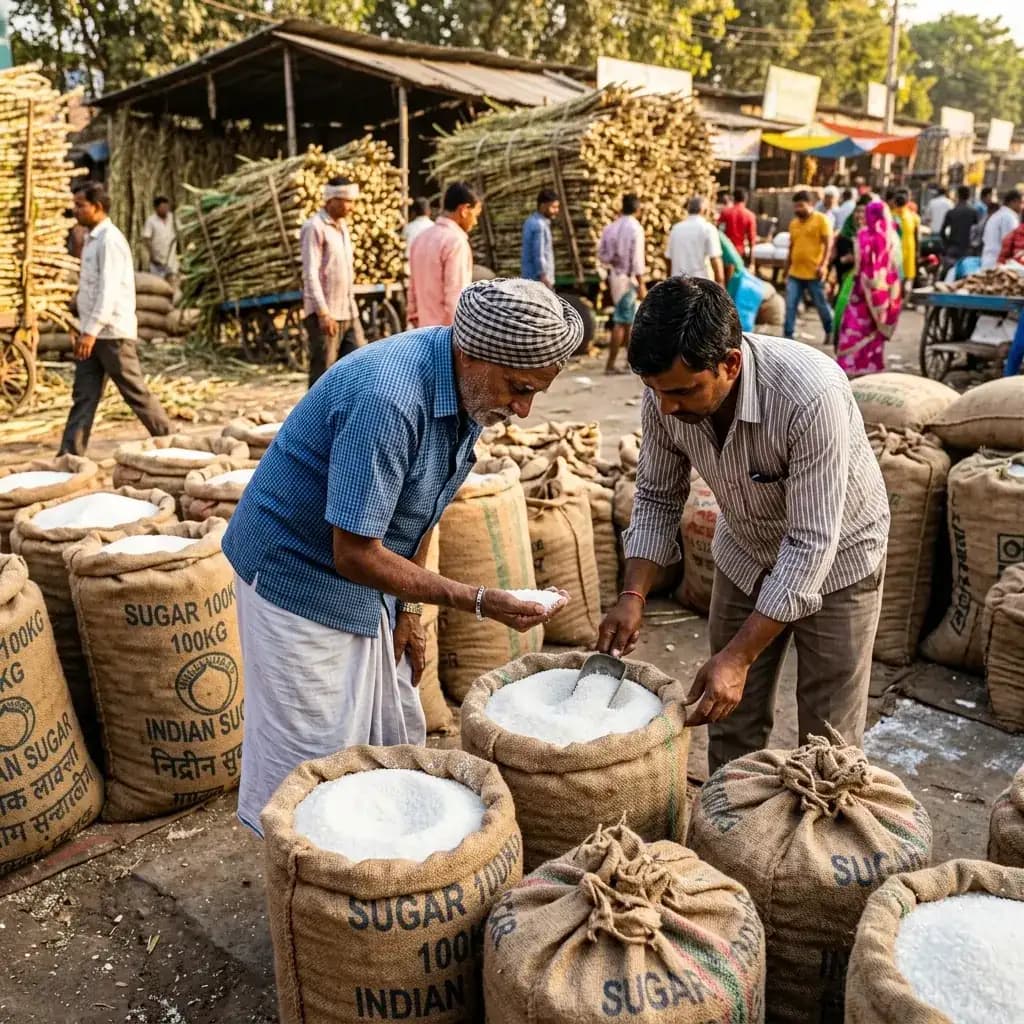
Sugar (Cheeni), extracted primarily from sugarcane in India, is one of the most heavily traded and heavily regulated commodities in the country. As the world's second-largest producer and the largest consumer of sugar, India's domestic sugar prices have significant implications for both household budgets and the immense food processing industry.
From your daily morning tea to the multibillion-dollar beverage, confectionery, and bakery industries, sugar is ubiquitous. Wholesale sugar prices are closely monitored not just by traders in mandis, but by sugar mills, the government, and bulk industrial buyers.
India's Sugar Production Landscape
🏭 The Sugar Mills
Unlike many crops traded entirely in mandis, sugar is manufactured in massive sugar mills. Farmers sell sugarcane directly to the mills at state or central advised prices (FRP/SAP). The mills then process the cane into sugar, molasses, and bagasse. Wholesale sugar is primarily sold directly from the mill gates (ex-mill rates) to large traders.
📍 Top Producing States
Maharashtra and Uttar Pradesh are the titans of Indian sugar, together accounting for over 60% of the country's total output. Karnataka is a strong third. Regions like Muzaffarnagar (UP) and Kolhapur (Maharashtra) are famous sugar trading hubs whose rates often set the benchmark for the rest of the country.
Sugar Grades (M, S, L)
- S-Grade (Small): Small-crystal sugar, most commonly consumed by households for daily use (tea, coffee, cooking). It dissolves quickly and is widely available in retail markets.
- M-Grade (Medium): Medium-crystal sugar, generally preferred by the sweet (mithai) industry, bakeries, and halwais. It usually commands a slight price premium over S-grade due to its specific demand.
- L-Grade (Large): Large, bold crystals used primarily in specific traditional sweets, prasad, and certain industrial applications. Produced in smaller quantities.
What Drives Sugar Prices?
Sugar is a highly sensitive commodity. Prices are influenced heavily by government regulations:
- Government Quotas: The central government dictates how much sugar mills can sell in the open market each month through a 'monthly release quota'. Restricting the quota artificially tightens supply, pushing prices up; increasing the quota cools prices down.
- Ethanol Blending Policy: Sugar mills can divert sugarcane juice or molasses to produce ethanol for fuel blending. When the government encourages ethanol production, less sugar is produced, leading to firmer domestic sugar prices.
- Export Restrictions: To keep domestic prices in check, India frequently caps or bans sugar exports. If exports are allowed, domestic supply drops and local prices increase.
- Summer & Festive Demand: Demand peaks during the summer (due to ice cream and beverage industries) and during the major festival seasons (Diwali, Dussehra) for sweet manufacturing.
🍚 Live Sugar Wholesale Rates Today
View Full DataFrequently Asked Questions About Sugar Prices
Q.What is the wholesale rate of Sugar today?
Based on live data from 20 mandis, the average Sugar wholesale price today is Rs 5,653/qtl. Rates range from Rs 4,900 to Rs 6,200. Note that ex-mill rates are usually quoted per quintal (100 kg).
Q.How are sugar prices controlled in India?
The government primarily controls prices using the 'Monthly Release Mechanism', dictating how much sugar mills can sell. Additionally, they manage export quotas and the Minimum Selling Price (MSP) of sugar below which mills cannot legally sell.
Q.Who are the biggest bulk buyers of sugar?
Roughly 60-65% of all sugar consumed in India is bulk industrial consumption. The biggest buyers are soft drink manufacturers, biscuit and bakery companies, confectionery makers, and the sweet/mithai industry.